
Paying for the War, Locked Out of the Peace
Europe has become Ukraine's indispensable financier and the loudest voice for security guarantees. It still cannot get Moscow to treat it as a negotiator.
In early June, Volodymyr Zelensky did something unusual for a wartime president. He wrote a letter to the public. Rather than wait for Washington's attention to drift back from Iran, he argued, Europe should take a central seat in any new round of talks, and he floated a face-to-face meeting to break the stalemate. Vladimir Putin answered within days. Europe could not mediate anything, the Russian president said, because it stood entirely on Ukraine's side. Until Russia was handed full control of the Donbas, there was nothing to meet about.
The exchange lasted barely a week and settled nothing. But it framed the question now hanging over the continent more sharply than any summit communiqué: Europe wants to shape how this war ends, and the one country it would have to negotiate with refuses to give it a chair.
From quiet paymaster to reluctant protagonist
For most of the war, Europe played a supporting role it was comfortable with. Washington led; European capitals wrote cheques and shipped equipment. That arrangement came apart over the course of 2025. Since Donald Trump returned to the White House, the United States has steadily wound down its funding for Ukraine's defence, and by the start of 2026 Kyiv was short of money and running out of road.
Europe moved into the gap, not entirely by choice. Brussels is now, by any measure, Ukraine's most important financial backer. That shift carries a weight European leaders had spent years avoiding. If the money and the weapons are increasingly European, so is the responsibility for whatever comes next.
Peacekeepers without a peace
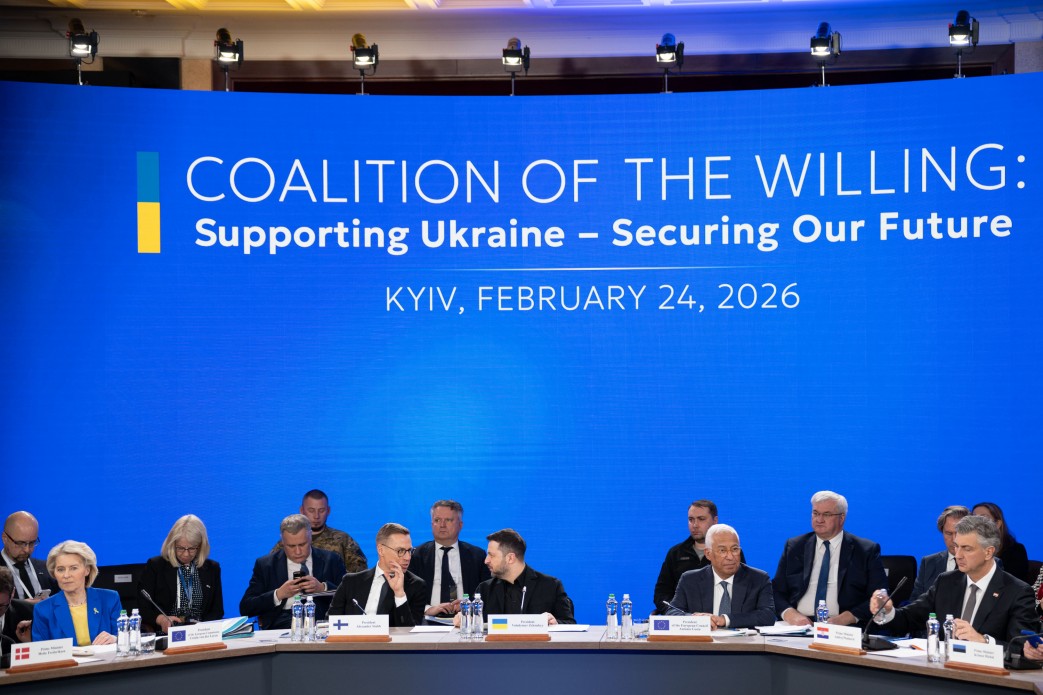
The clearest expression of Europe's new ambition is the Coalition of the Willing, a grouping of roughly 35 countries led by Britain and France. By late 2025, 26 of them had formally pledged to send troops to Ukraine as a "reassurance force" once a ceasefire takes hold. The blueprint imagines military hubs across the country, training missions, and air and naval support, all meant to make any future Russian attack look too costly to try.
Two problems stand in the way, and neither is minor. The first is timing. The force only deploys after a ceasefire, and there is no ceasefire, nor agreed terms for one. Planning the seating for a dinner before anyone has decided what will be served only gets you so far. The second is capability. A credible deterrent would lean heavily on American intelligence, surveillance and reconnaissance assets that Washington has not committed. Without them, analysts caution, the coalition risks being a deterrent in name only. Moscow has waved the whole idea away as unworkable.
Europe can find €90 billion when it has to. It still struggles to act when unanimity is required and one or two members would rather obstruct.
The €90 billion question
Money has exposed the same gap between intent and capacity. In December, EU leaders agreed to provide Ukraine with €90 billion for 2026 and 2027, a large share of it for military needs. The headline figure was a real commitment. How they arrived at it was the telling part.
The original plan was to use the roughly €210 billion in Russian central bank assets frozen in Europe, most of it held through Belgium, as the backing for the loan. The logic was clean: make the aggressor pay for the damage. The risk was real too. Belgium feared Russian retaliation and legal exposure for Euroclear, the clearing house that holds the assets and that Moscow is already suing for hundreds of billions. After negotiating deep into the night to reassure their smaller neighbour, leaders backed away from the asset plan and borrowed on the markets instead. Hungary and Slovakia, true to form, signalled they would fight even that.
The episode showed both faces of European power at once. The bloc can mobilise huge sums under pressure. It still moves slowly, and sometimes not at all, when a single capital decides to dig in.
How Moscow tells the story
Russia reads all of this very differently, and its version is worth understanding even if you do not buy it. After Britain, France and Germany set out five conditions for a "just and lasting peace" in London on 7 June, Foreign Minister Sergei Lavrov called the list an ultimatum and said trust could not be rebuilt that way. In a long essay that month, he argued that Europe's real goal was not to negotiate at all but to keep the Zelensky government standing as a base for continued confrontation, and that the West had spent decades using diplomacy as cover for pushing NATO and the EU eastward.
This is the Kremlin's framing, not a neutral account, and it skips past the fact that the war began with Russia's invasion. But it explains why Putin keeps shutting the door on a European role. Casting Europe as a hostile party rather than a possible broker is, from Moscow's side, the whole point.
A paradox with no easy exit
One analyst at the Peace Research Institute Oslo put the bind plainly this spring: Putin and Zelensky can both be right at the same time. Europe genuinely wants to help end the war, and Europe genuinely cannot do much to broker it, to the point where the bloc has struggled even to name a single negotiator to speak on its behalf.
So the continent does what it can do. It writes the cheques, arms the Ukrainian military, plans a force it cannot yet deploy, and sets itself a target of being ready to defend against Russia by 2030. That date says something. Europe is no longer banking on a quick settlement it can broker. It is preparing for a long contest it will have to fund, and perhaps fight, with or without a seat at the table.
Sources
Peace Research Institute Oslo (PRIO) — commentary by Pavel K. Baev on the Zelensky–Putin exchange and Europe's mediation gap, 22 June 2026. https://www.prio.org/comments/1897
Al Jazeera — "US backs security guarantees for Ukraine, as France and UK pledge troops," on the Coalition of the Willing summit and troop pledges, January 2026. https://www.aljazeera.com/news/2026/1/6/ukraine-talks-in-paris-yield-significant-progress-on-security-pledges
UK House of Commons Library — "Proposals for a Coalition of the Willing in Ukraine," on the UK–France declaration, military hubs and Russia's rejection, 2026. https://commonslibrary.parliament.uk/research-briefings/cbp-10412/
The Hill — opinion analysis on the coalition's reliance on US ISTAR assets and its credibility, December 2025. https://thehill.com/opinion/international/5661264-coalition-willing-ukraine-security/
NPR — "EU leaders agree on Ukraine loan… without relying on frozen Russian assets," on the €90 billion package, December 2025. https://www.npr.org/2025/12/19/g-s1-102967/eu-leaders-agree-on-ukraine-loan
The Conversation — "EU agrees €90 billion loan to Ukraine… deep divisions," on Europe as Kyiv's top financial partner and internal splits, December 2025. https://theconversation.com/eu-agrees-90-billion-loan-to-ukraine-but-squabbles-over-frozen-russian-assets-expose-the-blocs-deep-divisions-272095
Istituto Affari Internazionali (IAI) — "Russia's Frozen Assets: A Litmus Test for the EU," on Euroclear, Belgium's exposure and the Russian lawsuit, April 2026. https://www.iai.it/en/publications/c41/russias-frozen-assets-litmus-test-eu
CEPA — "Wartime Assistance to Ukraine," on the US drawdown and European funding mechanisms (SAFE, PURL), January 2026. https://cepa.org/comprehensive-reports/wartime-assistance-to-ukraine-the-successes-failures-and-future-prospects-of-us-and-eu-support-models/
GlobalSecurity.org — full text of Sergei Lavrov's article "Ukraine, Europe and Global Security" and the "London ultimatum" framing, 19 June 2026. https://www.globalsecurity.org/wmd/library/news/russia/2026/06/russia-260619-russia-mfa01.htm
Council of the EU (Consilium) — Paris Declaration of the Coalition of the Willing on security guarantees, January 2026. https://www.consilium.europa.eu/en/press/press-releases/2026/01/06/robust-security-guarantees-for-a-solid-and-lasting-peace-in-ukraine-statement-of-the-coalition-of-the-willing-issued-by-france/